-
The fragile ceasefire agreement between Israel and Hamas, brokered in early October 2025 with mediation from the United States, Egypt, and Qatar, is under increasing strain. While the truce remains officially in place, a series of escalating incidents and mutual accusations have raised fears that the agreement may soon unravel entirely — if it hasn’t already in practice.
The Ceasefire: A Brief Overview
The ceasefire deal, announced on October 10, 2025, was intended to halt weeks of intense hostilities that had left thousands dead and displaced more than a million Palestinians in Gaza. Under the terms of the agreement, both sides were to:
-
Cease all military operations;
-
Facilitate the delivery of humanitarian aid to Gaza;
-
Allow for the return of displaced civilians;
-
Begin negotiations over long-term political arrangements, including prisoner exchanges.
The agreement was hailed as a diplomatic breakthrough, especially given the catastrophic humanitarian situation in Gaza and growing international pressure for a halt to the fighting.
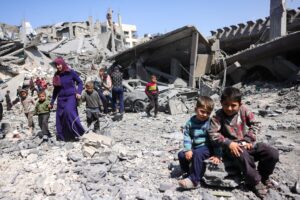
TOPSHOT – Children look on as people walk amid the rubble of a building destroyed in an overnight Israeli strike in Jabalia, in the northern Gaza Strip on March 18, 2025. Israel’s deadly strikes on Gaza drew global condemnation on March 18, as it said it had “no alternative” other than to resume military operations in order to bring home hostages. (Photo by Bashar TALEB / AFP) (Photo by BASHAR TALEB/AFP via Getty Images)
Mounting Violations and Rising Tensions
In the weeks since the ceasefire was enacted, however, both sides have accused each other of repeated violations:
-
Israel has conducted several airstrikes in Gaza, citing provocations by Hamas fighters. A recent strike reportedly killed over two dozen people, including women and children, according to Gaza’s health authorities. The Israeli military claims it was targeting militant positions in response to attacks on its forces near the southern city of Rafah.
-
Hamas and other Palestinian factions have also been accused of violating the truce by firing at Israeli troops and planting roadside explosives. Israeli officials maintain that these provocations forced them to respond militarily to protect their personnel and prevent infiltration attempts.
-
Gaza’s local authorities claim that Israel has violated the ceasefire over 40 times, including through sniper fire, delays in aid convoys, and restrictions on movement. They argue that the continued presence of Israeli forces in parts of southern Gaza also violates the spirit, if not the letter, of the agreement.
Humanitarian Access Still Blocked
One of the core components of the ceasefire was the unimpeded delivery of humanitarian aid to Gaza, where the UN warns that over 80% of the population now faces extreme food insecurity. But aid access remains slow and unreliable:
-
Aid convoys have been delayed or turned back at border crossings, often due to disputes over security checks and coordination with Israeli authorities.
-
Essential infrastructure in Gaza — including hospitals, water supplies, and electricity grids — remains largely nonfunctional, and efforts to rebuild have been hampered by the uncertain security situation.
-
International aid agencies have warned that the humanitarian crisis could spiral further out of control if access continues to be blocked or delayed.
Ceasefire or Collapsing Truce?
So, has the Gaza ceasefire been broken?
The answer depends on interpretation.
-
Technically, the ceasefire has not been officially declared null by either side. Diplomatic channels remain open, and no formal withdrawal from the agreement has been announced.
-
Functionally, however, the situation on the ground tells a different story. With repeated clashes, airstrikes, and broken promises, the ceasefire appears to be teetering on the edge of collapse.
U.S. and Qatari diplomats, who helped broker the agreement, continue to urge both parties to recommit to the ceasefire. A recent visit by American envoys sought to reinforce the terms of the truce, especially with respect to aid delivery and the return of hostages.
What’s at Stake?
The collapse of the ceasefire would have dire consequences for both the region and the international community:
-
Civilians in Gaza would be the first to suffer, as renewed fighting would likely hit densely populated areas with limited access to food, water, or medical care.
-
Israel faces increased international scrutiny, with growing calls for restraint and accountability in its military operations.
-
Regional spillover risks are also high, with potential flare-ups in the West Bank, Lebanon, or along the Israel–Egypt border if the truce breaks down completely.
Conclusion
While the Gaza ceasefire remains officially intact, it has been severely eroded by ongoing military operations, limited aid access, and a lack of trust between the parties. The coming days will be critical in determining whether the ceasefire can be salvaged — or if another cycle of devastating violence is imminent.
If the international community is serious about peace in Gaza, this moment demands urgent diplomacy, clear accountability, and meaningful humanitarian intervention. Without those, the current ceasefire may be remembered less as a turning point — and more as a missed opportunity.
-